Former Permanent Chairman of the Russian Association of Shanghai — G. K. Bologov,
Former members of its Executive Committee (last composition): Dr. P. I. Alekseenko and V. V. Krasovsky,
Former members of the Audit and Supervisory Commission (last composition): N. N. Pleshanov and B. M. Krannin,
Former Head of the Charitable Department of the Association — B. L. Kuper, and
Former Chairman of the Russian Chamber of Commerce of Shanghai — M. A. Moshkin,
Hereby, under oath on the Cross and the Holy Gospel, by our signatures certify and solemnly declare that—during his many years of spiritual ministry to the Russian émigré colony in Shanghai, throughout his tenure as Bishop, and later as Archbishop of Shanghai, from 1936 until the evacuation of Russian refugees from China—Bishop (and later Archbishop) John (Maximovich) showed himself to be a true and faithful servant of the Holy Church of Christ. During all this time, including the difficult years of the Second World War (1939–1945) and the postwar period up to 1949, we never observed any behavior or heard any words from him that could be interpreted as sympathy toward, or collaboration with, the Soviet regime or its representatives.
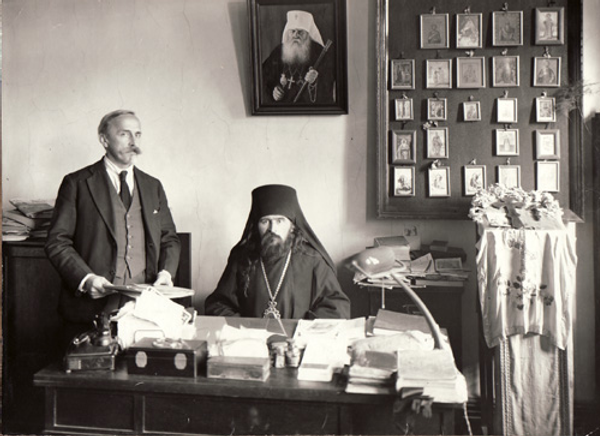
The ministry of the ruling Archbishop took place before the eyes of thousands of Russian anti-communists in Shanghai, who for the rest of their lives will remain grateful to Bishop John for saving the Shanghai Cathedral from seizure by the godless; for defending, besides that main church, all the Orthodox churches of Shanghai and preserving them under the jurisdiction of the Synod Abroad; for retaining the majority of the Orthodox clergy as followers of the ruling Archbishop of China, Victor, who was subordinated to the Russian Ecclesiastical Mission in China of the Soviet Church; and for his steadfast and self-sacrificing struggle against communist propaganda, which sought to entice Russian souls with false patriotism and promises of a better life, urging Russian people to take Soviet passports and repatriate—under Stalin’s amnesty—to the Soviet Union.
The mobilization of all Russian anti-communist forces in Shanghai to resist and oppose the rapidly growing Soviet propaganda and mass provocations, and the creation of the Russian Emigrant Association uniting within it about 6,000 White Russian people—would have been impossible without the spiritual leadership, steadfastness, and example of Bishop John.
Those thousands of honest Russian people who left China owe their survival, morale, and strong faith to his modest, wise, and powerful spirit. They later settled across the world—in the United States, France, Brazil, Australia, and even in Soviet Siberia—but all remember with gratitude their spiritual leader, Bishop John.
Many of us had to leave Bishop John just a month after his arrival in Shanghai, when his struggle against the Soviet emissaries had only just begun. Nevertheless, we were witnesses of this struggle and testify before God and people that Bishop John never strayed from the path of true Orthodox service and was a faithful and unbending fighter against Soviet infiltration into the Russian diaspora.
We, who witnessed this epoch of struggle—G. K. Bologov, who was Chairman of the Russian Emigrant Association from its founding, and M. A. Moshkin, Chairman of the Russian Chamber of Commerce and witness of the defense of the Shanghai Cathedral since 1938—along with the assistant warden of the Cathedral since 1943, who was close to Vladika (Bishop John), took direct part in this struggle and know all its details.
Pressure on Bishop John of Shanghai from the Soviet side began even before the end of the Second World War, when hierarchs of the Church Abroad in Manchuria—Metropolitan Meletius, Archbishops Nestor and Dimitry, and Bishop Juvenaly—sent letters to Archbishop Victor, head of the Chinese and Peking Missions, and to Bishop John of Shanghai, declaring that since the war was over, they should now recognize Patriarch Alexy of Moscow and All Russia, and suggested that Archbishop Victor and Bishop John follow their example and submit to the new Moscow Patriarch, as the legitimate head of the Russian Orthodox Church.
Because of the war and the lack of communication between the Synod Abroad and China, and being unaware of the true situation in Europe, America, and other countries, Bishop John wrote, after receiving this letter from the hierarchs in Harbin, to his superior, Archbishop Victor in Peking, advising not to take any action regarding recognition of the Patriarch until the Synod Abroad itself determined and clarified the canonical and ecclesiastical status of the Moscow Patriarchate. Bishop John fully supported Archbishop Victor, who remained loyal to the Synod Abroad, not recognizing the Moscow Patriarchate, which had been restored under the complete control of the Soviet authorities after the arrest and murder of Patriarch Tikhon and Metropolitan Peter (Polyansky), continuing the Bolshevik policy of subjugation of the Church.
In anticipation of the eventual fall of Shanghai and under the pressure of the Soviet consulate, which urged the clergy to commemorate Patriarch Alexy in the liturgy (according to Decree No. 630 of September 6/24, 1945), Bishop John, during the services, replaced the former commemoration of the “Orthodox Episcopate of the Russian Church.”
Meanwhile, communication with the Synod Abroad was finally restored on October 2, 1945, when Bishop John received a telegram from Switzerland signed by Metropolitan Anastassy, briefly stating that the Synod Abroad continued to exist, that Bishop John’s parents were alive and in Germany, and that the Metropolitan requested him to report on the state of the Church in China.
Bishop John sent a detailed report about the situation in Shanghai, requesting instructions, and forwarded the text of Metropolitan Anastassy’s telegram to Archbishop Victor in Peking.
The next telegram arrived in November from Archbishop Tikhon of Western America and San Francisco, informing that Metropolitans Anastassy, Vitaly, Ioasaph, and Jerome had reestablished contact among themselves and asked Bishop John to remain loyal to the Moscow Patriarchate no longer.
This was all that Bishop John needed to know, and when, at the beginning of December 1945, a letter arrived from Archbishop Victor ordering him to commemorate Patriarch Alexy at services, Bishop John categorically refused to do so, since the Patriarchate of Moscow remained under Soviet authority.